End of lodging moratorium would trigger onslaught of hotel development, some fear

BAR HARBOR, Oct. 24, 2025 - Did the Planning Board perform the final coup de grace for what remains of the residential community here?
As I previously feared and reported, the hospitality industry rose like a phoenix from the ashes of the “lodging moratorium” to gain more resolve and actual policy benefits which some fear will doom the town.
Owing to a redefinition of “guest room” - courtesy of the planning staff - hotel and other establishments are poised to gain occupancy in virtually every category of lodging in town, unless the current moratorium is extended so that it may be corrected by the electorate.
Otherwise, without the protection of the moratorium, the largest hotel project to appear before the Planning Board in years will sail through the application process just as the 46-room Pathmaker Hotel on Cottage Street did as a bed and breakfast in 2022.
Someone in the Planning Department decided last year it was a good idea to expand the definition to allow a room with multiple bedrooms to be defined as a single “guest room.”
The floor plan below by Ocean Properties LLC for the Park Entrance Motel shows a section of two-bedroom and three-bedroom units which would all qualify as a single guest room under the planning staff’s new definition.
“Ocean Properties used the new guest room definition when planning their proposed rebuild of the Park Entrance Motel in Hulls Cove,” stated Warrant Committee member Carol Chappell, who performed a deep analysis of the project application and made it public last month.
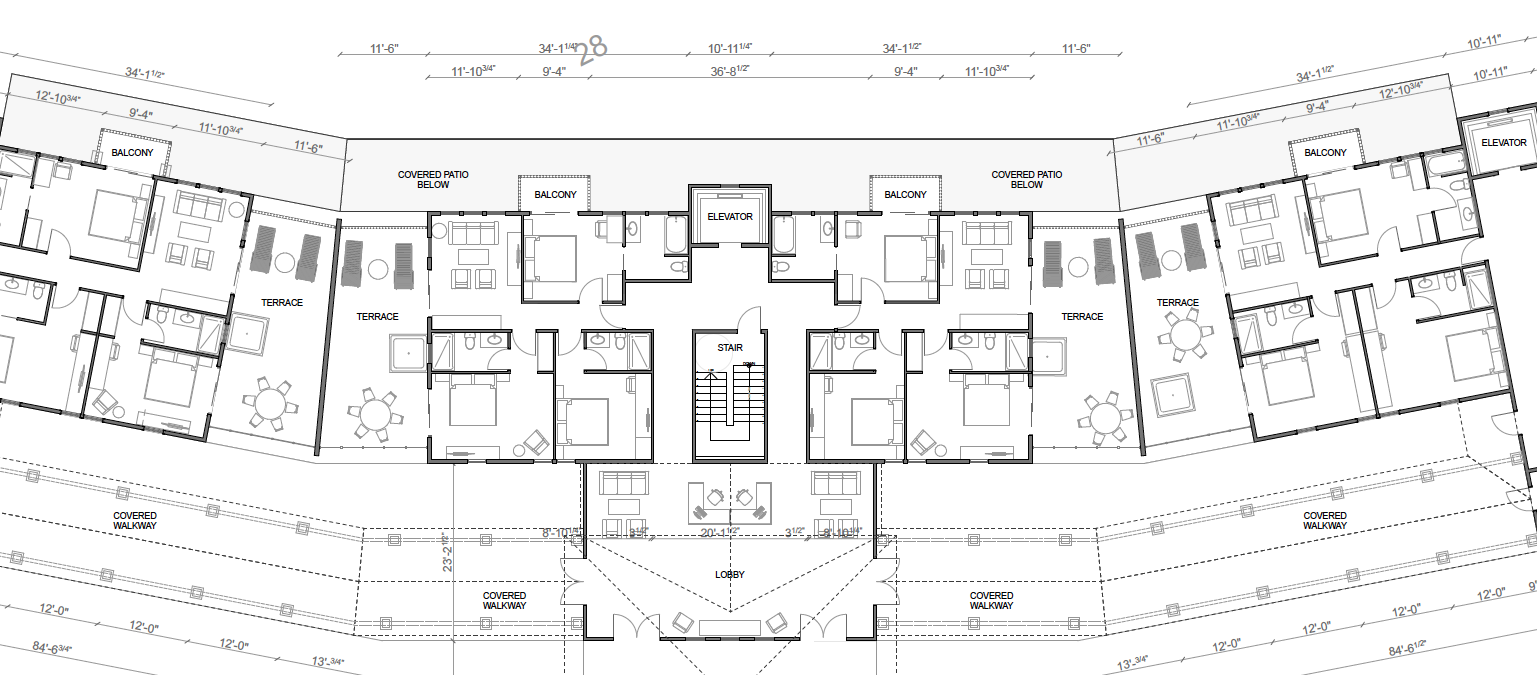
“OP hopes to build 24 suites - 20 with 3 bedrooms, 4 with 2 bedrooms each - so 68 bedrooms with en-suite bathrooms. Plus each suite has a nice size, separate living room - 24 more rooms. These could accommodate pull out sofas.”
Where would all those people park their cars since the the town requires one park spot for every “guest room?” Chappell and others have asked.
And are the town’s water and sewer infrastructure ready to accept the biggest flow of detritus from that new hotel?
The code officer already has been alerted by one councilman to monitor use of a municipal lot downtown by guests from the abutting Pathmaker hotel.
Three planning members - Teresa Wagner, Guy Dunphy, John Seavitt - said the guest room definition change alone was enough to warrant extending the moratorium so that it could be corrected.
But Planning chair Millard Dority was a man in a hurry. He had decried the moratorium and scolded the planning staff for not working faster to present its findings so the moratorium could end and allow the board get back to its business of reviewing applications, including OPL’s huge hotel in Hulls Cove.
Dority had already declared that he “loved” the hotel project in a previous meeting.
Dority dominated the two board workshops on the moratorium. He said repeatedly he did not favor initiatives targeting a single industry.
In June 2019, Dority, who was then director of campus planning, buildings and public safety at the College of the Atlantic, used his email privilege to urge the COA community to reject an amendment to the Land Use Ordinance to block cruise ships with more than 500 passengers from being allowed to tie up to town piers. That citizens initiative was approved overwhelmingly by a vote of 493 to 384.
Citizen activist Charles Sidman, who called himself a friend and supporter of COA for 40 years, wrote then COA President Darron Collins expressing shock that COA would side with the cruise ship industry and campaign against his citizens initiative.
Bar Harbor’s rich history of targeting individual industries included its landmark November 2021 ordinance banning new, non-owner-occupied short-term vacation rentals until they are reduced to below 9 percent of its housing stock.
In November 2022, voters targeted cruise ship visitation and capped daily passenger visits to 1,000 a day. Voters repelled an effort by the Town Council last year to overturn that cap.
At Dority’s persistent urging, the board voted 4-3 on Oct. 14 to recommend that the Town Council not extend the current 180-day moratorium.
In the interim between the Sept. 22 workshop and the Oct. 14, three members - vice chair Ruth Eveland, Kathy St. Germain and Clark Stivers - went from voicing concerns about hotel overdevelopment to supporting Dority.
One elected official said:
“The moratorium was to put the brakes on development so that they could enact the types of change that they want to make in the Comp Plan.
“The pace of large lodging development is expected to be too fast to keep up with the changes that need to be made - is the LUO adequate to protect the town?
“And they somehow couldn’t even figure out what their job was. That was the crux of the matter. Is the LUO adequate, or does it need to be changed to protect the town from this aggressive, radical redevelopment of Bar Harbor, planned by a few developers?”
The moratorium never truly articulated its purpose and once again left that task to its lawyer and a town manager who spent most of its first two years on Chapter 50 and Chapter 174 - one of which was rejected after voters and the other awaiting the same fate.
The idea of expanding the guest room definition first came up more than a decade ago when the West Street Hotel was first proposed in 2009, recalled Angela Chamberlain, who was the town’s code enforcement officer for 25 years. (This is the definition of institutional memory.)
She said the hotelier wanted to define adjoining rooms as one room if occupied by the same party.
A decade later, hotelier Tim Harrington came along to re-imagine the old Colony Motel in Hulls Cove with a plan for cottages with two bedrooms.
That’s when Chamberlain said the town realized that it didn’t have an adequate code to cover all considerations.
The new definition of guest room was inserted as an amendment to the LUO in November 2024 while many citizens were fixated on the proposed Chapter 50 and other amendments.
The Planning staff did little to draw attention to it as it went for a vote.
Dority and other Planning Board members spent considerable air time bemoaning how badly written was the moratorium assignment they received from the council. They argued whether they could edit the wording. Dority said no. But was he correct?
The board got preoccupied with digging into data, and then taking as data the interpretations made by town staff.
If the fire and police chiefs - two of the most political positions in town - said they could handle the challenge during the tourism season, then what about the rest of the year. Is the town overpaying for police and fire in winter?
Dority referenced the two chiefs more than once that they get more calls from bars and restaurants than hotels as if that was prima facie evidence of the benign nature of hotel patrons.
Really?
So who goes to bars and restaurants at night? Hotel owners themselves will tell you that their customers empty out to go into the park during the day.
So doesn’t that translate to fewer calls from police and fire?
And where do those hotel patrons go for dinner?
Where was the data to support the two chiefs’ assertion that these were different people?
The whole process was a dialectic nightmare.
One elect official said,
“What was the moratorium about? Was it to control the number of people in town, or was it to change land-use patterns?
“The people that came to the planning board, rather the council, were concerned about the loss of housing and the loss and the change of the character of the town that a lodging development was being proposed next to a school, that a lodging development was being proposed that was aggressively trying to buy out a much needed dental service.”
Dority got support from at least one non board member, Tom St. Germain, part owner of the Pathmaker who said:
“Enacting a moratorium on a single industry is not fair. There are multiple large projects going ahead right now. I’ve watched many institutions and organizations in this town make and enact plans for the future, building new research facilities, schools, libraries, housing, student centers, maintenance facilities, all of which contribute to the town’s infrastructure and usage of public services.”
FOOTNOTE: Tom St. Germain is not exactly an impartial observer. He was the planning chair before Dority. The Pathmaker Hotel was built while he was still a sitting member. But he and his partner Stephen Coston deserve some credit keeping the Pathmaker Hotel and its restaurant open year-round, as is the Inn at Mount Desert, owned by Coston. Every APPLL business which is suing the town is seasonal. I wrote this appreciation to the year-round businesses that keep the lights on during winter last January. Owners who are willing to take that risk on behalf of the community deserve some consideration in my opinion. To ensure their businesses may sustain themselves, they will eventually have to provide year-round housing as David Witham has. David told me he has about 150 year-round employees in Maine. He starting to turn some of his houses into homes for his year-round staff, some of whom enroll children in the school. Will St. Germain and Coston follow?
COA ,FOA and the Bar Harbor Chamber of commerce all want the same thing: more tourism while the park has already surpassed its capacity.